Most startups should start with about €1,500 to €3,000 a month in ad budget, focused on one or two high-intent campaigns, and give it 90 days. That budget is paid to Google. If you want help running it, our paid ads service is a separate fee: €750, €1,250 or €2,000 a month depending on your ad budget, plus a one-off €500 setup. Your budget depends on your industry's cost per click, your conversion rate and what a customer is worth to you.
You've got a product that works. Customers are coming in, slowly. Someone tells you Google Ads will fix that. So you open the platform, stare at the interface, and ask the question every startup founder asks: how much should I actually spend?
The honest answer: it depends. But that's not helpful, so let's get specific. First, one thing that confuses almost everyone.
Two bills, not one
When you run Google Ads with help, you pay two separate things:
- What you pay Google (or Meta): your ad budget. This is the money that buys the clicks. It goes straight to the platform, never through us, so you always see exactly what was spent.
- What you pay us: a management fee for running the campaigns, tracking and reporting. For paid ads that is €750 a month if your ad budget is under €5K, €1,250 if it is €5K to €20K, and €2,000 if it is over €20K, plus a one-off €500 setup. Prices are in euro, without VAT.
So a €3,000 ad budget with our paid ads service means €3,000 to Google plus €750 to us each month, with a one-off €500 setup and a 3-month minimum. At the low end that fee is a big share of the total, which is a fair reason to start small and learn on your own first. The rest of this guide is about the first bill: the ad budget.
Start with your unit economics, not a budget number
Before you pick a number, you need to know three things: what a customer is worth to you (LTV), what you can afford to pay to acquire one (target CPA), and what clicks cost in your industry. Without these, any budget is a guess.
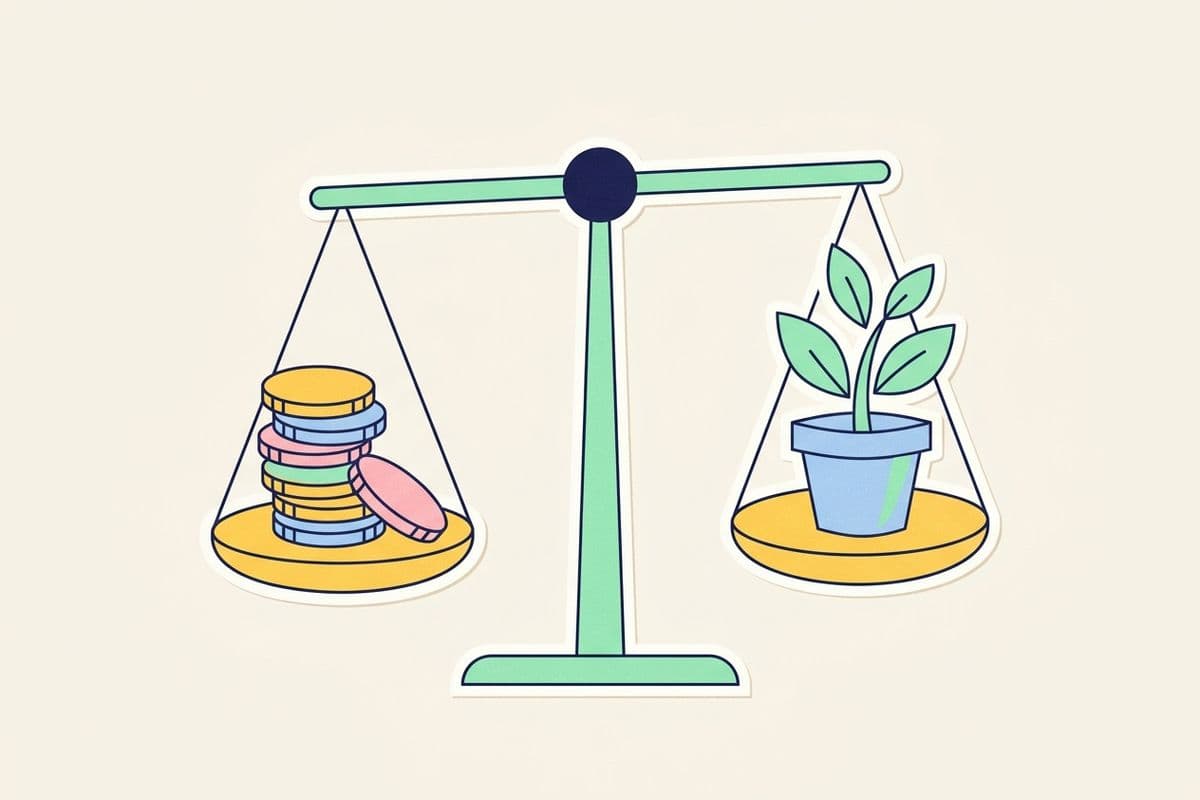
If your average customer is worth €5,000 over their lifetime, spending €500 to acquire them is a good deal. If your product sells for €29 a month and churns at 10%, spending €500 per customer is a disaster. The math comes first. Always.
The practical starting point: €1,500 to €3,000 a month
For most B2B startups, we suggest starting with an ad budget between €1,500 and €3,000 per month. Here's why that range works:
- Below €1,500, you don't get enough clicks to learn anything useful. Google's algorithm needs data to optimize, and you need data to make decisions.
- At €2,000 to €3,000, you'll generate enough volume across one or two campaigns to see patterns within a few weeks.
- Going well above that makes sense only after you've validated your messaging, landing pages and conversion funnel.
The 90-day rule
Commit to 90 days before judging results. Month 1 is learning. Month 2 is optimizing. Month 3 is when you see what Google Ads can actually do for you. Pulling budget after 3 weeks because "it's not working" is one of the most expensive mistakes startups make.
Where to put the budget: high-intent keywords only
The biggest mistake startups make is spreading budget across too many campaigns. You don't need brand awareness campaigns on day one. You need to capture people who are already looking for what you sell.
Focus on bottom-of-funnel search campaigns. Target keywords that signal buying intent, like "best [your category] for [your audience]" or "[competitor] alternative." These clicks cost more, but they tend to convert better than generic awareness terms.
Cost-per-click benchmarks by industry
Your industry determines how far your budget goes. These ranges come from WordStream's 2025 Google Ads benchmarks and Codedesign's guide to Google Ads costs in Europe. They are published figures from those sources, not our own data, and they move every year, so check the originals before you plan around them:
- SaaS / Software: €2 to €8 per click
- E-commerce: €0.50 to €3 per click
- Professional services: €3 to €12 per click
- Finance / Insurance: €5 to €15 per click
- Healthcare: €2 to €8 per click
As a worked example (the arithmetic is ours, the inputs are illustrative): at €3 per click and a 3% conversion rate, €3,000 a month buys about 1,000 clicks and 30 leads. At €10 per click, the same budget gives you 300 clicks and 9 leads. Tighter, but still workable if your deal size is large enough.
When to scale up
Scale when you have proof, not hope. Specifically, increase budget when:
- Your cost per acquisition is below your target CPA consistently for 3+ weeks
- Your conversion rate has stabilized (not still swinging wildly)
- You've tested at least 3 or 4 ad variations and know what messaging works
- Your landing page converts at a healthy rate (the Unbounce benchmark data is a useful reference point. If you are well below it, fix the page before spending more)
When you do scale, go up 20 to 30% at a time. Doubling budget overnight usually hurts performance because it changes how Google's bidding algorithm behaves.
Doing it yourself or getting help
If your ad budget is small, managing ads yourself is reasonable. Google's interface has gotten better, and there are good resources out there. But be honest about the time cost. Most founders underestimate how many hours campaign management actually takes.
As the budget grows, so does the cost of a bad setup: wasted clicks, tracking that doesn't work, campaigns stuck in learning. That is where help pays for itself, if it does at all. Our paid ads service is built for it: Google and Meta campaigns with clear tracking and reporting, and our own tool, Pilo, giving you and our experts one daily view of spend and results. We also wrote an honest comparison of agency vs in-house marketing if you want the full picture.
Is AI recommending you or your competitor?
We ask ChatGPT, Claude, Gemini and Perplexity the questions your buyers would ask and show you who they name. Your result is ready in about two minutes.
The bottom line
Start with an ad budget of €1,500 to €3,000 a month. Focus on high-intent search campaigns. Commit to 90 days. Track your cost per acquisition obsessively. Scale when the numbers prove it works, not before. And keep the two bills straight: the ad budget is yours to spend with Google, and any management fee is a separate decision.
The startups that win at Google Ads aren't the ones with the biggest budgets. They're the ones who test methodically, cut what doesn't work fast, and double down on what does.